

Most people evaluate AI output by feel — does this seem right, does it sound good, is this roughly what I wanted. The problem isn’t that the answer is bad. It’s that there’s no standard to measure it against, because that standard was never set before the question was asked.
Ask AI to summarise a document and it will produce something — complete, confident, reasonably structured. But a summary for who? How long? Focused on what? Without those decisions made upfront, any answer can feel good enough in one reading and slightly off in the next, because you’re not checking it against a fixed bar. You’re checking it against your mood.
Now try: “write a three-sentence summary of this document for a non-technical executive, covering only the business impact, not the technical steps.” That’s a standard. Three sentences — countable. Non-technical — checkable sentence by sentence. Business impact only — you know exactly what to cut if it wanders. The answer either meets it or it doesn’t.
This matters more for outputs that don’t have obvious right answers — summaries, drafts, analysis, strategy — where the model will always produce something that sounds finished. A finished-sounding answer and a correct one look identical on the surface. The only way to tell them apart is to have decided in advance what correct means for this specific ask.
Defining good first also changes the question itself. The act of writing “three sentences, non-technical executive, business impact only” forces you to commit to decisions you might have left vague — and those decisions often reveal what you actually needed, before any answer arrives. Sometimes it turns out the real task was different from the one you’d started typing.
“A problem well stated is a problem half solved.” — Charles Kettering, Head of Research, General Motors
That’s what defining good does — it finishes half the work before the model writes a word.
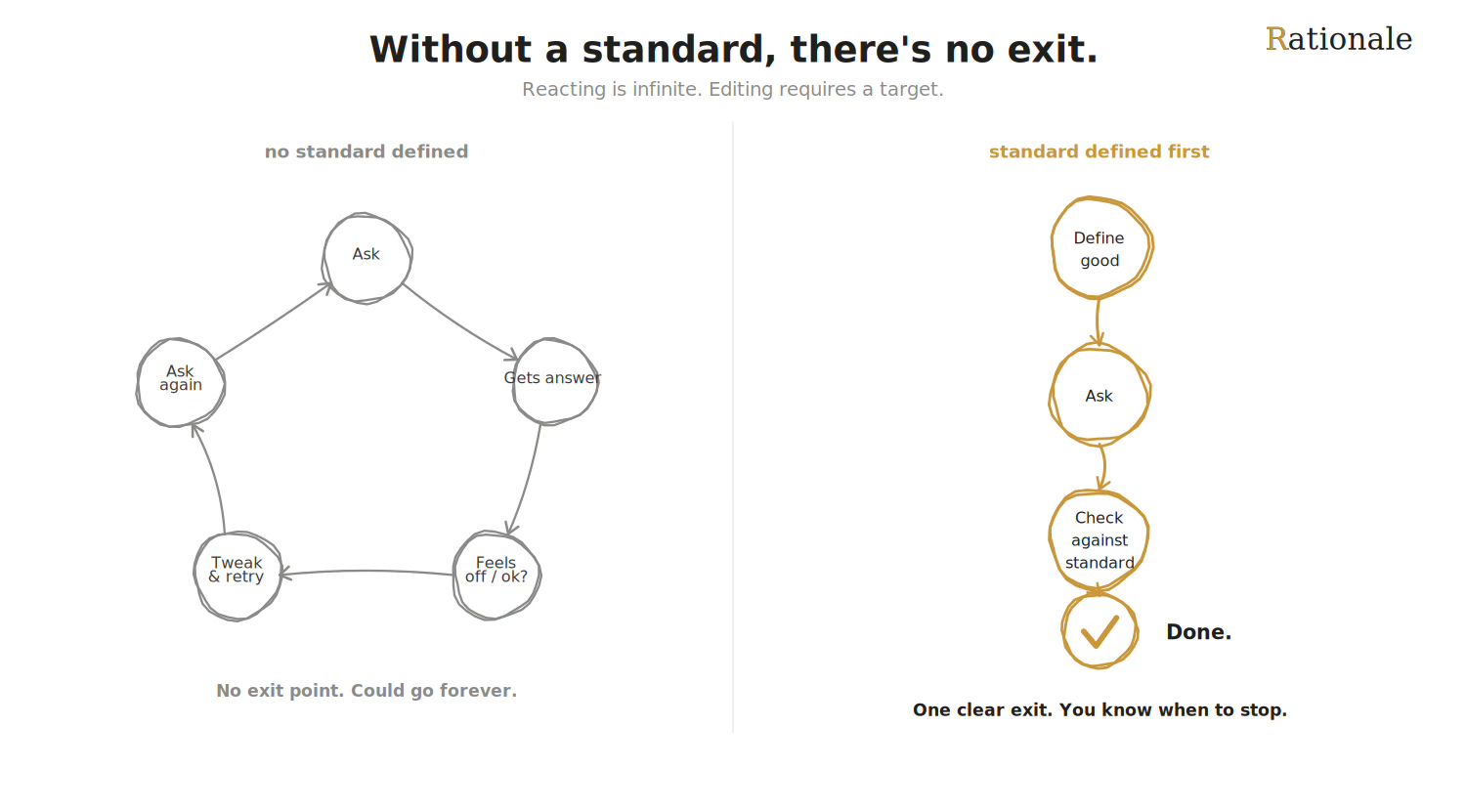
The practical habit: before sending any AI request where the output requires judgment to evaluate, write one line that describes what a correct answer would look like. Not the question — the answer. Length, tone, audience, what’s in scope, what isn’t. This takes thirty seconds and gives you something you don’t have otherwise: a way to stop.
For an individual, this is the difference between editing an answer and just reacting to it. Editing requires a target. Reacting is infinite. For a business, this is where AI-assisted work either holds a quality bar or doesn’t — and the gap between teams that produce clean, consistent output and teams that produce variable, re-worked output almost always traces back to whether someone decided what good looked like before the first draft was generated.
— Arvind, Rationale One short issue a week. No jargon, no hype — just the reasoning behind what’s changing.