

The way an engineer writes a request to an AI is now part of the work itself. The format of that request — not just the words inside it — shapes what comes back.
Most people miss this. They treat the prompt box like a search bar: type, press enter, hope. But AI models don’t read like a search engine. They look for structure — headings, lists, sections, code blocks — because that’s what they were trained on. Almost every project on GitHub, every technical documentation site, every engineering wiki is written in Markdown. That’s the format the model’s understanding of “well-organized information” was built on.
When you write in clean Markdown, you’re not being pedantic. You’re meeting the model in the language it learned to read.
Here’s the difference in practice.
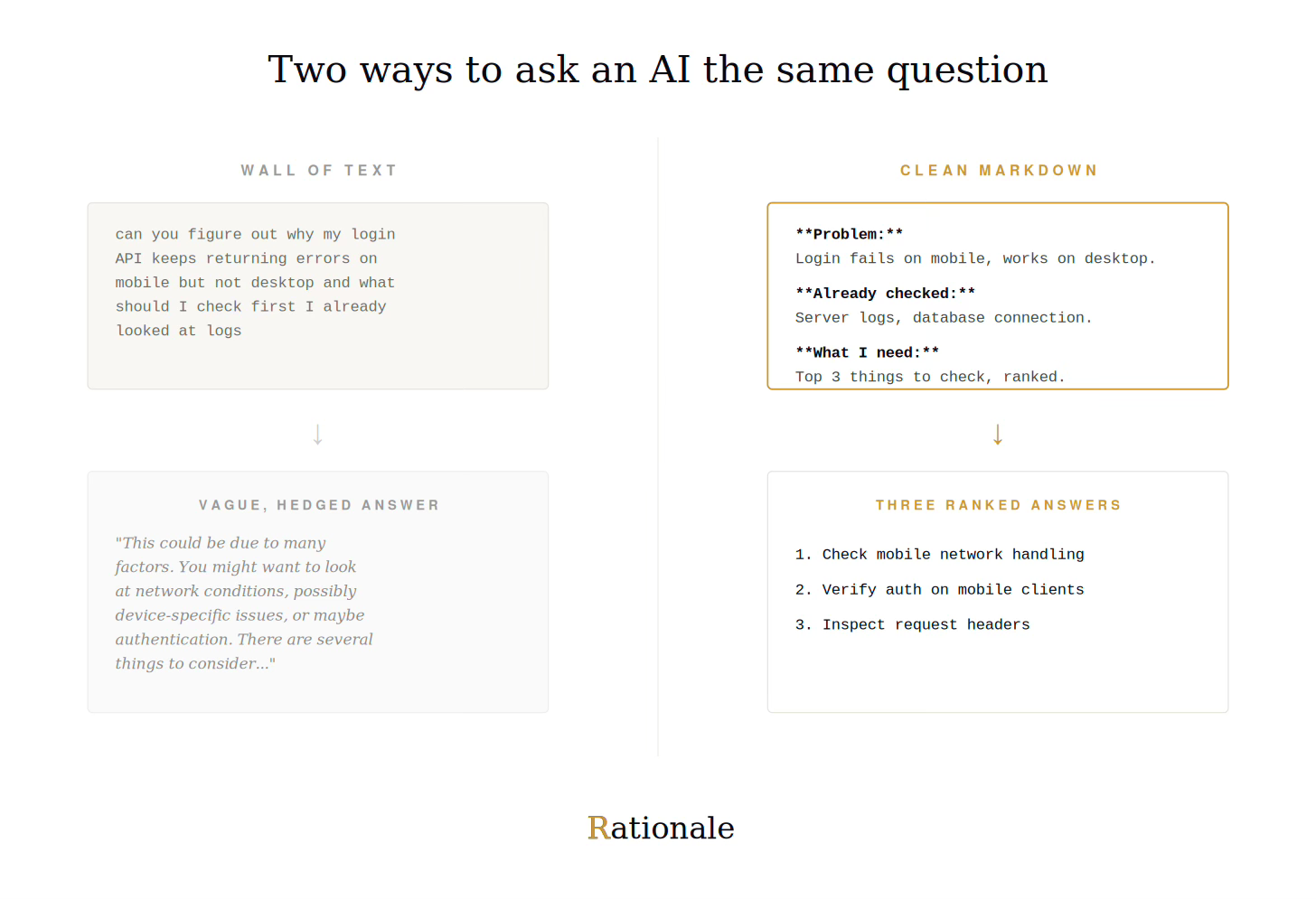
A typical messy request:
can you figure out why my login API keeps returning errors on mobile but not desktop and what should I check first I already looked at logs
The model has to guess what you actually want — a diagnosis, a checklist, a code review — and usually returns a long hedged answer covering all of it.
The same request, structured:
**Problem:** Login API returns errors on mobile, works on desktop.
**Already checked:** Server logs (clean), database connection (fine).
**What I need:** Top 3 things to investigate next, ranked by likelihood.
That reliably returns three concrete suggestions in priority order. Same information. Different structure. Different output.
The same pattern works for code reviews, design feedback, project summaries. State the input. State what you want back. Let structure do the rest.
This isn’t a clever trick. The model reads structure as meaning. Headings signal what’s coming. Bullet points signal parallel items. Code blocks signal raw input. Each piece of Markdown narrows what the model thinks you want.
The cost of getting this wrong is invisible. You don’t see the better answer you didn’t get. You get a mediocre one and move on, while engineers who structure their requests well quietly extract more value from the same tools.
For an individual engineer, spend the extra fifteen seconds to write the request as a short structured block. The output gets sharper. The habit becomes automatic within a week.
For someone leading a team, name it out loud. Engineers who treat AI interaction as a written skill will outpace those who treat it as casual chat. The gap won’t show up in any dashboard — it’ll show up in who ships faster and debugs cleaner. Train for it like you’d train for code review.
Markdown was never just a documentation format. It’s the shared grammar between engineers and the tools they spend half their day talking to. Treating it as a core skill — not a footnote — is what separates the engineers who’ll lead this era from the ones who’ll be confused by it.
— Arvind, Rationale One short issue a week. No jargon, no hype — just the reasoning behind what’s changing.