

With a person, you learn to read hesitation — a pause, a hedge, a “let me check.” AI has none of that to give you. It states a verified fact and a plausible guess in exactly the same confident tone, because it isn’t hiding any doubt. Tone tells you nothing. Only the content does — and code is where that gap gets expensive.
Ask AI to write a discount calculation, and it writes something like this:
def apply_discount(price, discount_percent):
    return price - (price * discount_percent / 100)
This compiles. It passes the obvious test — apply_discount(100, 10) returns 90, exactly as expected. It ships, because nothing about it looks wrong. The syntax is clean, the logic reads correctly, and that’s exactly why nobody questions it.
The problem only shows up with real prices. apply_discount(19.99, 15) doesn’t return a clean number — it returns something like 16.991499999999998, because computers store fractional amounts like this imprecisely. No single test catches it, because no single transaction looks broken enough to flag. The function is wrong for currency specifically, while being syntactically perfect in every other way.
That gap doesn’t cost anything on day one. It costs something a few thousand transactions later, when fractions of a cent have quietly compounded into a real reconciliation mismatch, the books don’t tie out at month end, and someone loses a day tracing it back to one confidently written, fully-passing line of code. Compiling and passing tests were never proof the logic was right — only proof it resembled working code closely enough that nobody checked further.
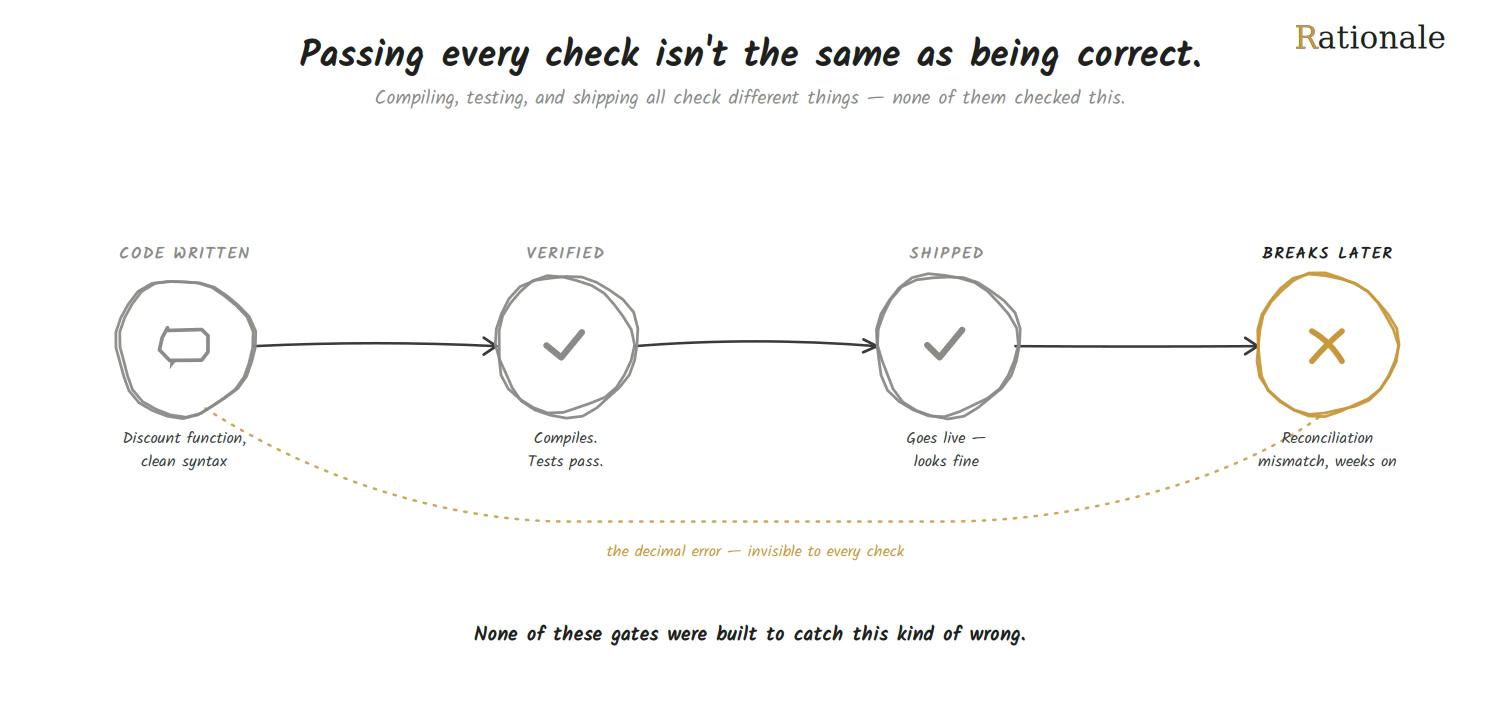
That’s the same failure as a confidently wrong answer in plain language, just wearing different clothes: a plausible pattern standing in for verification that never actually happened, at every stage — the model that wrote it, the test that passed it, the reviewer who approved it.
For a business, the fix isn’t trusting AI-written code less. It’s recognizing that “it compiled, it passed, it shipped” was never a substitute for checking the actual logic — and that the real cost of skipping that check rarely shows up at launch. It shows up months later, in a discrepancy nobody can trace back to the one confident line that caused it.
— Arvind, Rationale One short issue a week. No jargon, no hype — just the reasoning behind what’s changing.