

A simple format you've probably already used without knowing it — and why it's quietly becoming one of the most important tools of the AI era.
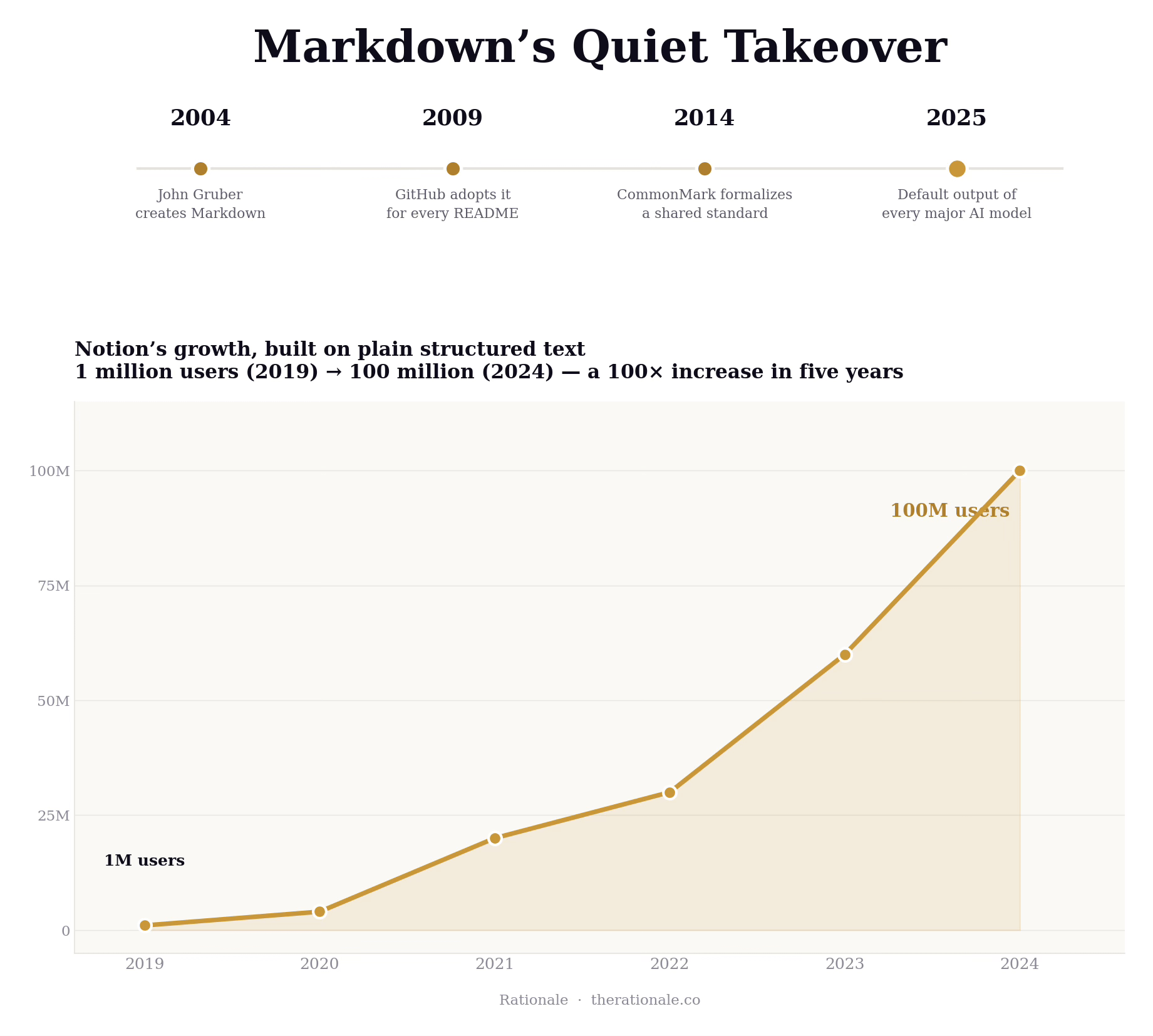
Claude, ChatGPT, Gemini, GitHub, Notion, Obsidian. Different companies, different purposes, all built on the same quiet format underneath: Markdown. That’s not a coincidence, and the reason behind it tells you something useful — whether you write code for a living or run a team that doesn’t.
Start with what AI tools actually need. When an AI writes you an answer, that answer has to be readable by you immediately, and it also has to be processable by other software without anyone translating it first. Most formats fail one side of that. A Word document looks fine to a person but is messy for software to read. A spreadsheet is easy for software but unreadable to a person at a glance. Markdown is just plain text with a few light symbols added — a # for a heading, a dash for a bullet — and both a person and a machine can read it the same way, instantly. That’s the whole reason every major AI assistant defaults to it. It’s the one format that doesn’t force a choice between the two audiences reading it.
It also helps that Markdown takes about ten minutes to fully learn. Most tools that add structure to writing — page layout software, complex publishing platforms — take real time to master. Markdown’s entire rule set fits on one page. And low effort to learn is not a small detail — it’s the actual mechanism behind why something spreads. The easier a tool is to pick up, the more people use it. The more people use it, the more other tools get built to support it. The more tools support it, the easier it becomes to keep using. That loop is the entire reason a niche blogging format from 2004 is now the default output of every serious AI system in 2025.
There’s one more thing worth knowing: a Markdown file never expires. It’s just text. No special software is required to open it, no subscription, no risk that the company behind some proprietary format shuts down and takes your files with it. A Markdown file written today will open exactly the same way in twenty years. Anything you write in it, you actually keep — not in a legal sense, just in the practical sense that nothing can lock you out of your own writing.
None of this requires you to know how to code. If you ever write instructions for an AI — a prompt, a brief, a set of guidelines you want it to follow closely — structuring it with simple headings and bullet points measurably helps the AI follow it more reliably. You’re not coding. You’re organizing your thoughts the way a clear-headed person already would, and that happens to be exactly the structure the machine understands best too.
And if you lead a team rather than write the instructions yourself, the pattern matters even more than the format. The tools winning this moment in AI aren’t always the most powerful or the most complex. Often they’re the simplest ones a person and a machine can both use without friction. That’s worth carrying into how you evaluate any new AI tool for your team — not “how powerful is it,” but “does it add complexity or remove it.” The tools that quietly remove complexity are the ones still standing in five years.
— Arvind, Rationale One short issue a week. No jargon, no hype — just the reasoning behind what’s changing.